The World Respects Us Again Trump
Simply many heighten concerns about wellness of U.S. political system
The election of Joe Biden equally president has led to a dramatic shift in America'due south international image. Throughout Donald Trump's presidency, publics effectually the world held the Usa in low regard, with most opposed to his foreign policies. This was peculiarly true among key American allies and partners. At present, a new Pew Enquiry Heart survey of xvi publics finds a significant uptick in ratings for the U.Southward., with strong back up for Biden and several of his major policy initiatives.
This analysis focuses on public opinion of the United States in 16 advanced economies in N America, Europe and the Asia-Pacific region. Views of the U.S. and its president are examined in the context of long-term trend data. The report also explores how people view President Joe Biden's proposed policies and characteristics.
For this report, we use data from nationally representative surveys of sixteen,254 adults from March 12 to May 26, 2021. All surveys were conducted over the telephone with adults in Canada, Belgium, France, Federal republic of germany, Greece, Italian republic, the netherlands, Kingdom of spain, Sweden, the Great britain, Commonwealth of australia, Japan, New Zealand, Singapore, South korea and Taiwan.
This study was conducted in places where nationally representative telephone surveys are feasible. Due to the coronavirus outbreak, face-to-confront interviewing is not currently possible in many parts of the world.
Here are the questions used for the study, along with responses, and the survey methodology.
In each of the xvi publics surveyed, more than half-dozen-in-ten say they have confidence in Biden to practice the correct thing in world affairs. Looking at 12 nations surveyed both this year and in 2020, a median of 75% express confidence in Biden, compared with 17% for Trump last year.
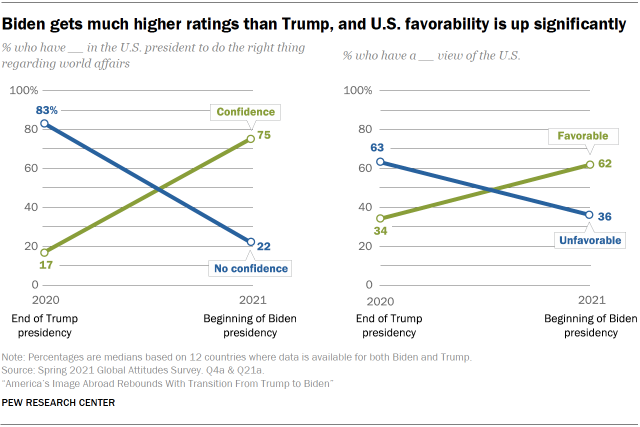
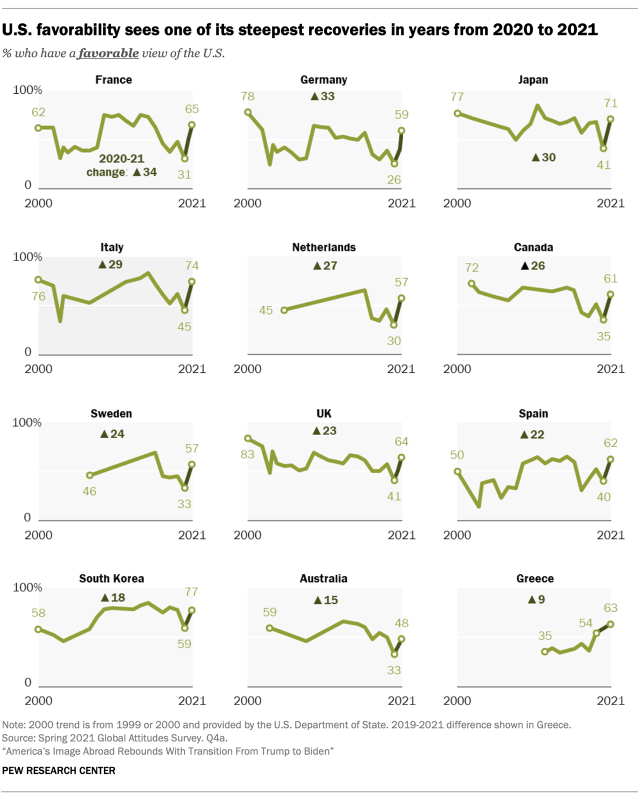
During the by 2 decades, presidential transitions take had a major bear on on overall attitudes toward the U.S. When Barack Obama took office in 2009, ratings improved in many nations compared with where they had been during George W. Bush-league's administration, and when Trump entered the White House in 2017, ratings declined sharply. This year, U.S. favorability is upwardly once again: Whereas a median of merely 34% across 12 nations had a favorable overall opinion of the U.South. last twelvemonth, a median of 62% now hold this view.
In French republic, for example, just 31% expressed a positive opinion of the U.S. last twelvemonth, matching the poor ratings from March 2003, at the acme of U.S.-French republic tensions over the Iraq War. This yr, 65% see the U.S. positively, approaching the high ratings that characterized the Obama era. Improvements of 25 per centum points or more are also found in Germany, Japan, Italy, the Netherlands and Canada.
Still, attitudes toward the U.South. vary considerably across the publics surveyed. For instance, only about one-half in Singapore and Australia have a favorable stance of the U.South., and just 42% of New Zealanders hold this view. And while 61% see the U.South. favorably in Taiwan, this is actually down slightly from 68% in a 2019 poll.
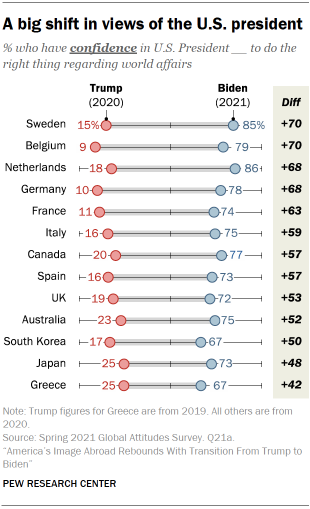
In most countries polled, people make a stark distinction between Biden and Trump as globe leaders. Nearly eight-in-10 Germans (78%) have confidence in Biden to do the right thing in globe diplomacy; a year ago, just x% said this about Trump. Similar differences are found in Sweden, Belgium and kingdom of the netherlands, and in all nations where a trend is bachelor from 2020 there is a difference of at to the lowest degree forty per centum points.
Every bit is the case with views of the United States every bit a whole, conviction in U.South. presidents has shifted dramatically over the past two decades, particularly in Western Europe. In Frg, the Uk, Spain and France – iv nations Pew Inquiry Center has surveyed consistently – ratings for Bush-league and Trump were similarly low during their presidencies, while this year conviction in Biden is fairly similar to the ratings Obama received while in part.

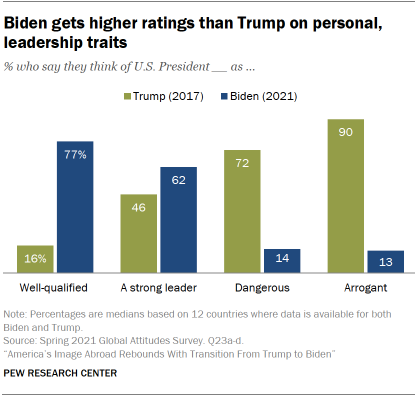
Biden's loftier ratings are tied in part to positive assessments of his personal characteristics, and here again the dissimilarity with Trump is stark. Looking at 12 countries polled during the first year of both their presidencies, a median of 77% describe Biden as well-qualified to exist president, compared with 16% who felt this way about Trump. Few think of Biden every bit arrogant or dangerous, while large majorities practical those terms to Trump. Assessments of the two leaders are more similar when it comes to being a potent leader, although even on this measure, Biden gets much more positive reviews than his predecessor.
Loftier levels of confidence in Biden are also tied to favorable views of his policies, several of which accept emphasized multilateralism and reversed Trump assistants decisions. The electric current survey examines attitudes toward four of the Biden administration's primal policies and finds widespread support for all four.
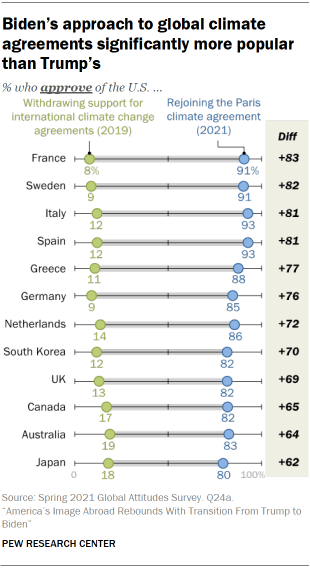
A median of 89% across the 16 publics surveyed approve of the U.S. rejoining the World Health Organisation (WHO), which the U.S. withdrew from during Trump's presidency. A median of 85% also back up the U.S. rejoining the Paris climate agreement. Trump's withdrawal from the Paris understanding was met with widespread criticism, and information technology was overwhelmingly unpopular in the surveys the Center conducted during his presidency. For example, in 2019 just 8% in France approved of Trump'due south plans to withdraw support for international climatic change agreements, compared with 91% who at present dorsum Biden'southward reentry into the agreement.
Support for the Biden administration's proposal to organize a summit of democracies from around the world is likewise widespread, with a median of 85% maxim they corroborate. In that location is simply slightly less support (a median of 76%) for Biden's plan to allow more refugees into the U.S. (Biden campaigned on allowing more refugees into the state, briefly reversed his initial goal to raise the refugee cap from levels set by the Trump administration, and so walked back the reversal amidst criticism.)
Biden has besides made articulate that he plans to strengthen America's commitment to the NATO alliance. Every bit the electric current poll shows, NATO is viewed positively by the member states included in the survey. (See "NATO continues to be seen in a favorable calorie-free past people in member states" for more than.)
Although Biden's more than multilateral approach to foreign policy is welcomed, there is still a widespread perception that the U.S. mainly looks later on its own interests in world affairs. More than half in near of the publics surveyed say the U.S. does not have their interests into account when information technology is making strange policy decisions, although fewer feel this mode in Japan, Greece and Federal republic of germany.
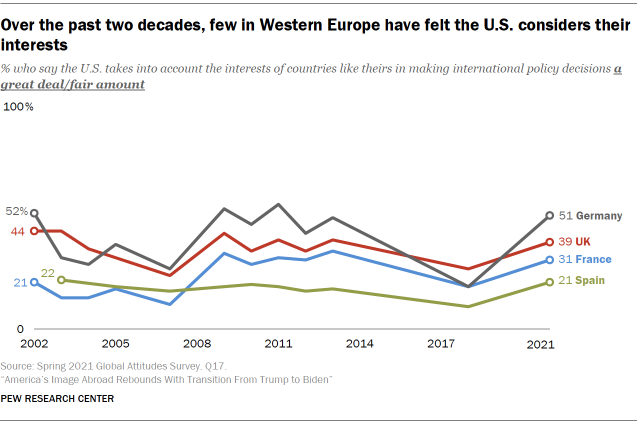
Doubts virtually the U.S. considering the interests of other countries predate the Trump administration, and this has been the prevailing view – even among shut U.S. allies – since the Eye began asking the question in 2002.
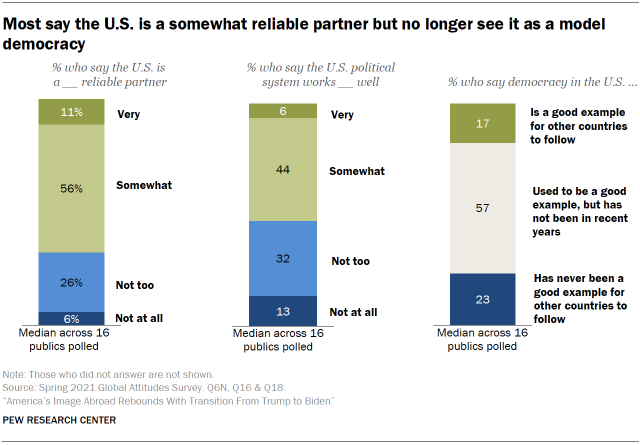
Despite widely reported bilateral and multilateral tensions between the U.Due south. and many of its major allies and partners over the last 4 years, relatively few people describe the U.Due south. as an "unreliable partner." Only neither do they limited great conviction in the U.South. every bit an ally. Across the xvi publics polled, a median of 56% say the U.Due south. is somewhat reliable, while simply 11% describe America as very reliable.
In add-on to the concerns some accept about how America engages with other nations, there are also concerns about domestic politics in the U.Southward. The sixteen publics surveyed are divided in their views about how well the U.S. political organization is functioning, with a median of only 5o% proverb it is working well.
And few believe American democracy, at least in its current state, serves as a good model for other nations. A median of merely 17% say commonwealth in the U.S. is a good case for others to follow, while 57% say information technology used to be a good case merely has not been in recent years. Another 23% exercise not believe it has ever been a good example.
One of the reasons for the depression ratings the U.S. received in 2020 was the widespread perception that it was treatment the global pandemic poorly. In the current poll, the U.S. gets significantly more positive marks for how it is handling COVID-nineteen, merely nearly even so say the U.S. has done a bad chore of dealing with the outbreak (for more than, see "Global views of how U.Southward. has handled pandemic have improved, but few say it's done a good job").
In his first overseas trip as president, Biden is preparing to attend the G7 summit in the U.k. and the NATO summit in Brussels. Once there, he volition meet with two other leaders widely trusted for their handling of world affairs.
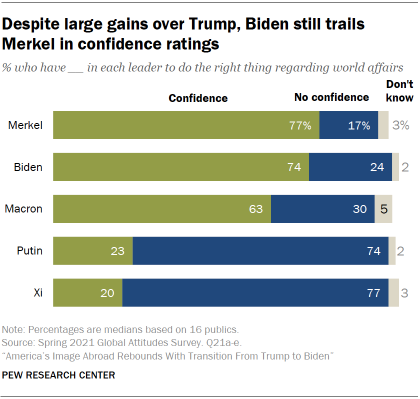
German Chancellor Angela Merkel actually receives slightly higher ratings than Biden: A median of 77% across the xvi publics surveyed limited confidence in Merkel's international leadership. A smaller median of 63% voice confidence in French President Emmanuel Macron.
Relatively few trust Russian President Vladimir Putin to practise the right thing in world affairs, while Chinese President Xi Jinping has the lowest ratings on the survey.
These are among the major findings from a Pew Inquiry Centre survey conducted among 16,254 respondents in sixteen publics – not including the U.South. – from March 12 to May 26, 2021. The survey as well finds that views toward the U.Southward. and President Biden often differ by ideology and age.
Spotlight: How views of the U.South. vary with political ideology and historic period
Credo
In many of the publics surveyed, ideological orientation plays a office in how people view the U.S. and American democracy.
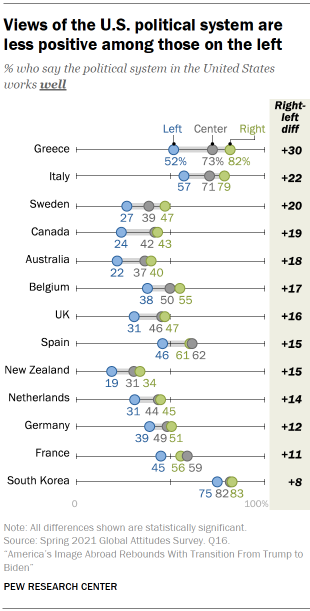
- People who place themselves on the correct of the political spectrum are more likely to have a positive view of the U.Southward. in nearly every country where ideology is measured. And this general pattern has non changed much over fourth dimension, with those on the right property a more favorable view of the U.S. during the Trump and Obama administrations also.
- In 11 countries, people on the right are more than likely than those on the left to say democracy in the U.S. is a practiced example for other countries to follow. And in a similar set of countries, they are also more than probable to call up the U.South. political system works well.
- Overall, majorities on the left, middle and right of the political spectrum corroborate of the policies included in the survey. All the same, Biden'due south decision to allow more refugees into the U.S. is decidedly more popular among people on the left. In about one-half the countries, those on the left are also more than likely to corroborate of the U.S. rejoining the Globe Health Organization.
Age
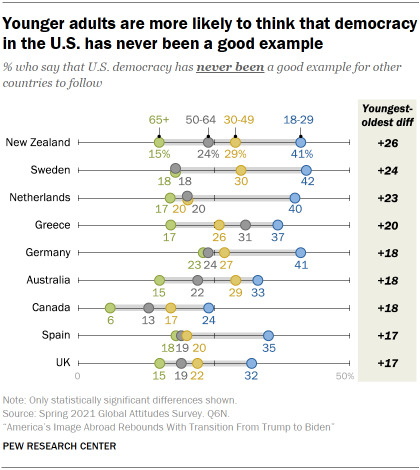
In general, favorable views of the U.Due south. practise not vary based on age in Europe or the Asia-Pacific region. But age is a cistron when information technology comes to confidence in the U.S. president and other earth leaders.
- Across most places surveyed, adults ages 65 and older are significantly more than likely than those ages 18 to 29 to have conviction in Biden to do the correct things in globe affairs. Trust in Biden is so high overall, withal, that at to the lowest degree half in all age groups hold this view.
- Older adults too have more confidence in Merkel in half of the surveyed areas. Trust in Putin shows the opposite design, with younger adults more probable to have confidence in the Russian president in most of the publics surveyed.
- Adults nether thirty besides deviate from older adults in their views of American democracy. In about one-half of the publics surveyed, younger adults are more probable to think commonwealth in the U.S. has never been a practiced model for other countries to follow.
Favorable views of the U.South. accept rebounded
In every place surveyed except New Zealand, around half or more than have a favorable opinion of the U.S. Ratings are highest in Southward Korea, where 77% have positive views of the U.Southward., and around two-thirds or more than in Japan, France and the Great britain say the same.
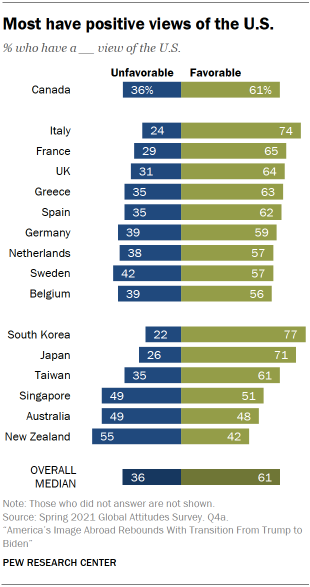
These broadly positive views reflect a sharp uptick since last summer, when ratings of the U.Southward. were at or near celebrated lows in most countries. For instance, in Kingdom of belgium, where only a quarter had favorable views of the U.S. last year, a 56% majority say the same today.
In France, the UK and Frg, positive views accept increased even since this past Nov and December. Surveys in these three countries found tepid views of the U.S. concluding Dec – after major media outlets had chosen the election for at present-President Joe Biden but before his inauguration and the violent storming of the U.S. Capitol on January. 6 past a mob of Trump's supporters. Evaluations ranged from twoscore% favorable in Federal republic of germany to 51% in the UK. Today, positive views have increased past double digits in all three countries, with around six-in-ten or more than in each of these countries now proverb they view the U.S. favorably.
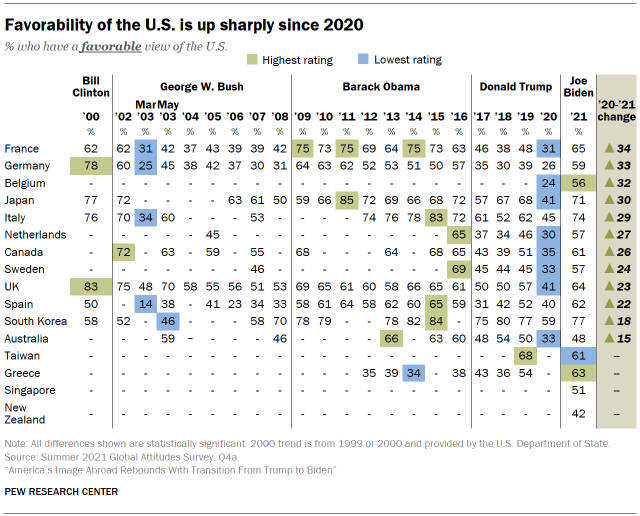
In many places, favorable views of the U.South. accept at present rebounded to roughly the aforementioned levels that were seen toward the end of President Obama'southward second term. Take France equally an instance: The share who take positive views of the U.S. has more than than doubled since final year, from 31% – a tape low – to 65%, which is comparable to the 63% who had favorable views of the U.Southward. at the cease of the Obama administration.
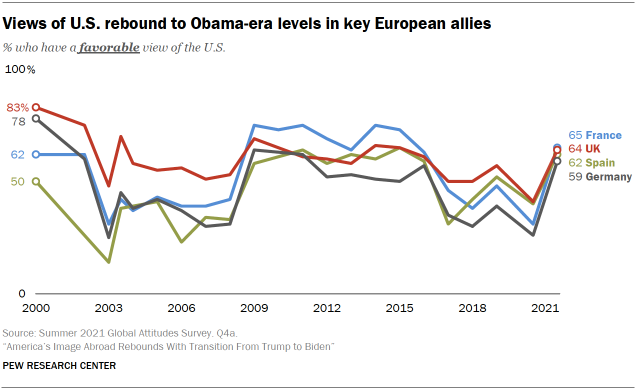
Views of American republic and strange policy both factor into how people feel nigh the U.S. For instance, those who think the U.S. political arrangement is working well and those who call up American democracy is a skilful case for other countries to follow are much more likely to take favorable views of the U.S. Similarly, those who think the U.South. is a reliable partner and who think the U.South. takes other countries' interests into account also have more than positive views of the superpower. And people who believe the U.S. is doing a adept job of dealing with the COVID-19 pandemic are more than likely to express a positive view of the country.
Some concerns about performance of U.S. democracy
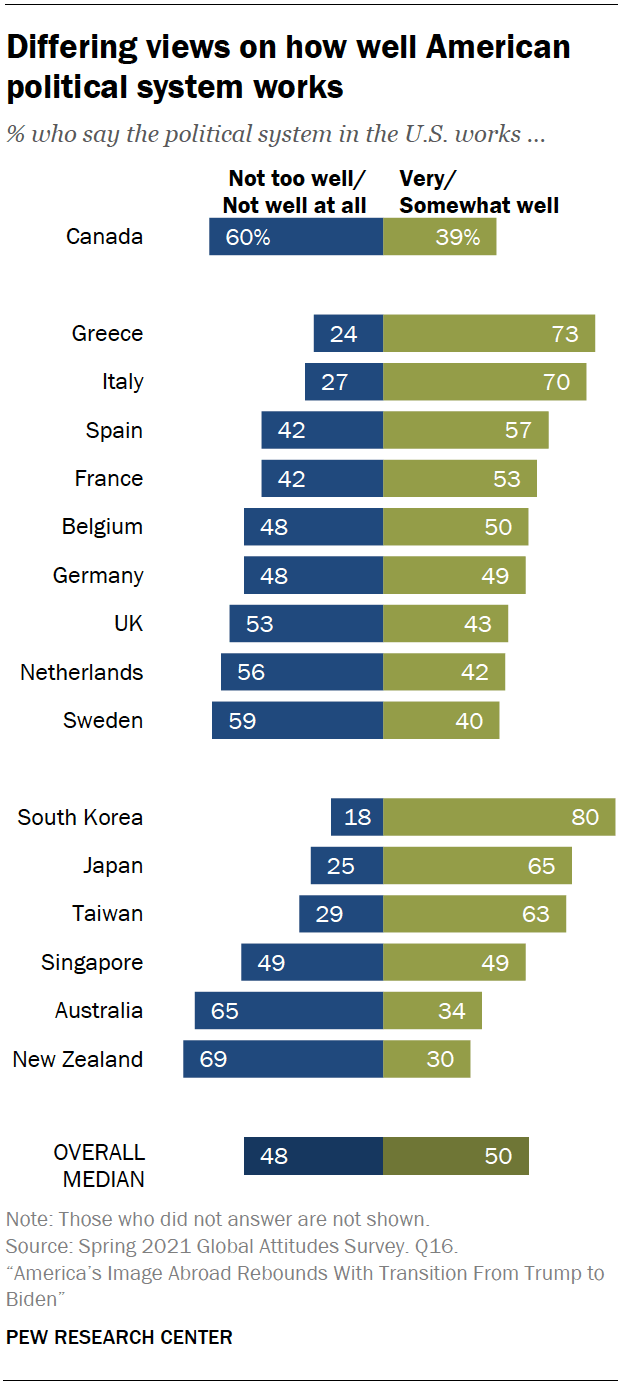
Majorities in New Zealand, Australia, Canada, Sweden and holland are skeptical of how the U.S. political system functions. On the flip side, majorities in South Korea, Greece, Italy, Japan, Taiwan and Espana limited at least some confidence in the American system of government.
Even so, even among publics where majorities think the U.S. political system works at least somewhat well, this confidence is lukewarm: At almost, near a fifth say the American political organization functions very well. In most places surveyed, the share who say this is smaller than i-in-ten.
While attitudes are mixed about how well the U.S. political system functions, publics in the advanced economies surveyed are largely skeptical that commonwealth in the U.Southward. is a good example for other countries to follow. Across all publics surveyed, no more than about three-in-ten say the U.S. is currently setting a proficient case of democratic values.
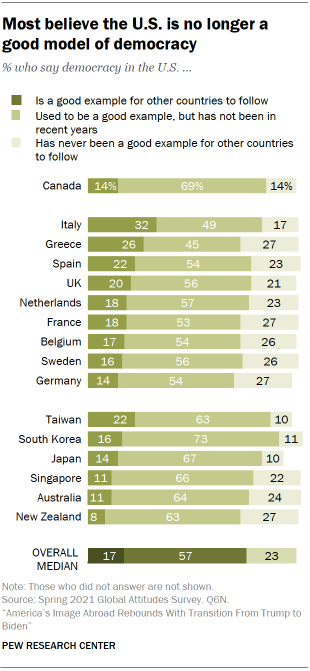
Rather, majorities or pluralities say American republic used to be a skilful example but has not been in recent years, and up to virtually a quarter reject the idea that the U.S. has ever been a proficient model of democracy.
Merely about a third say the U.S. considers their interests in strange policy
Despite the precipitous uptick in favorable views of the U.S. and its president in 2021, most people surveyed keep to say the U.S. doesn't take into account the interests of publics similar theirs when making international policy decisions. Beyond the sixteen publics, a median of 67% say the U.S. does not take their interests into account too much or at all, while only 34% say Washington considers their interests a cracking deal or fair corporeality.
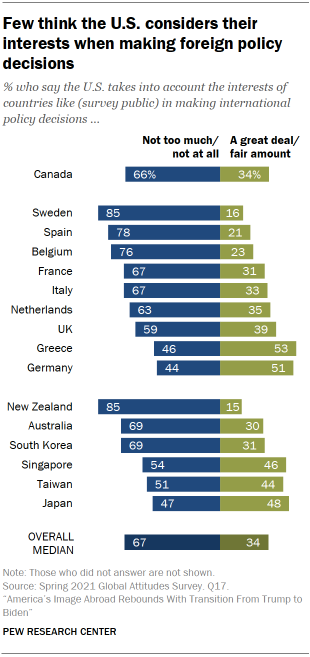
Across the European countries surveyed, at that place is a fair amount of variation in this assessment. As few as 16% in Sweden say the U.S. considers Sweden'south interests when making strange policy, but roughly half or more in Greece and Frg do. In Deutschland, this represents a 32 percentage betoken increase since 2018, when this question was last asked. Despite this uptick, replicated across many of the European nations surveyed in both years, majorities in the region say the U.South. does not consider their interests when making foreign policy decisions.
Asian-Pacific publics also tend to say Washington discounts their interests, including 85% among New Zealanders. Around 7-in-x in Australia and South korea, every bit well as 54% in Singapore, hold that the U.Southward. does not consider their interests when making foreign policy.
In Taiwan, which has a complicated unofficial relationship with the U.Due south., 51% say the U.S. does not consider their interests, while 44% say it does. Among Japanese adults, opinions are nearly equally divided between people who say the U.S. takes their views into business relationship when making foreign policy and those that say the U.S. does non. (During the survey fielding, Japanese Prime Minister Yoshihide Suga visited the U.S., attending what was Biden'due south first face-to-face meeting with a foreign leader since he became president.)
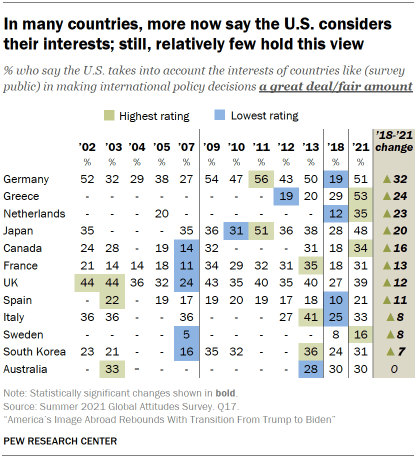
There accept been significant increases in the shares saying the U.Due south. considers their interests when making foreign policy since the question was last asked during the Trump presidency. In addition to the leap in Germany, at that place take been double-digit increases in such sentiment in Hellenic republic, the Netherlands, Nihon, Canada, France, the UK and Espana. In Greece and Canada, this is the highest such reading in a Pew Research Eye survey, even compared with the Obama era.
Yet, the predominant sentiment, going dorsum to 2002 when the question was first asked, is that the U.S. does not consider the interests of countries like theirs. The election of Joe Biden has non fundamentally changed that.
Well-nigh say that the U.S. is a somewhat reliable partner
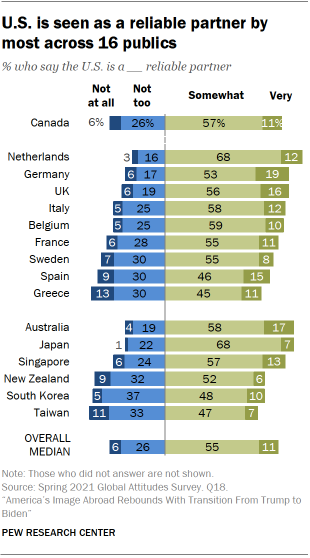
Across the xvi publics surveyed, majorities or pluralities say the U.Due south. is a somewhat reliable partner. But in no public surveyed exercise more than two-in-10 say that the U.S. is a very reliable partner.
At the same time, fewer than iv-in x say the U.S. is a non also reliable partner, and in no public do more than 1-in-seven say that the U.S. is a not at all reliable partner.
The sentiment that the U.S. is a very or somewhat reliable partner is highest in holland (80%), Australia (75%) and Japan (75%). But 44% in Taiwan and 43% in Hellenic republic say the U.S. is non besides or not at all reliable.
Nearly all say relations with U.S. will stay the same or get better over the next few years
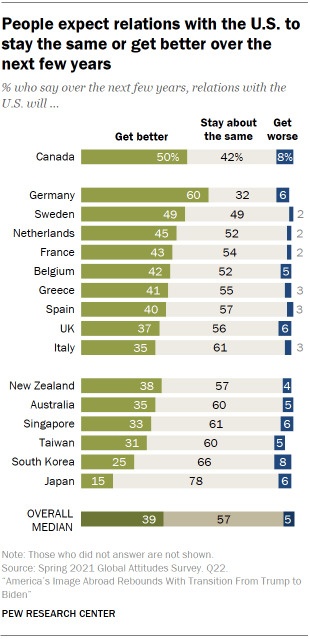
When asked whether relations with the U.S. will get better, worse or stay the same over the next few years, a median of 57% across the 16 publics say they will stay the same. While a continuation of current relations with the U.Southward. is the about common response, a median of 39% say relations will get better and only 5% say they will get worse.
The just place where a majority thinks relations with the U.South. volition get better is Germany (60% say this), where attitudes about the transatlantic alliance take become increasingly pessimistic in contempo years. One-half of Canadians also say relations with their southern neighbor volition get ameliorate over the adjacent few years.
In 2017, when this question was asked specifically well-nigh then-newly elected President Trump and his consequence on bilateral relations, the near common reply was likewise that they would remain the aforementioned. But back then, few said that relations with the U.S. would improve nether Trump, and significant portions of the population thought they would deteriorate, including 56% in Frg who said this.
High confidence in Biden across Europe, Asia-Pacific
In the commencement year of his presidency, Biden enjoys positive ratings from majorities in each of the publics surveyed. Overall, a median of 74% have confidence in the U.S. president to do the correct thing in earth affairs.
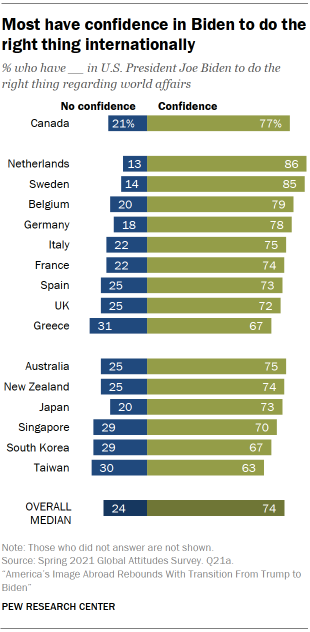
Confidence is particularly high in the Netherlands, Sweden, Belgium, Germany and Canada, where about eight-in-x or more trust Biden when it comes to international affairs. He receives his everyman ratings in Greece, S Korea and Taiwan, though more than six-in-x in each trust his handling of world affairs.
Widespread conviction in Biden contrasts starkly with views of his predecessor. Trust in the U.S. president was historically low in most countries surveyed during Trump's presidency. In many cases, even so, the share who have confidence in Biden is not every bit loftier as the share who had confidence in Obama at the start or end of his presidency.
Frg is a good example of this pattern. In 2020, but 10% of Germans had confidence in Trump to do the right affair in world affairs (matching a previous all-fourth dimension low earlier in Trump's presidency). Once Biden took office, confidence in the U.Southward. president increased past 68 percentage points in Germany, only information technology is still lower there than the all-time high of 93% in 2009, Obama's first year in role. A similar trend can be seen in Sweden, the Netherlands, France, Italian republic, Canada, Commonwealth of australia, South Korea and Japan.
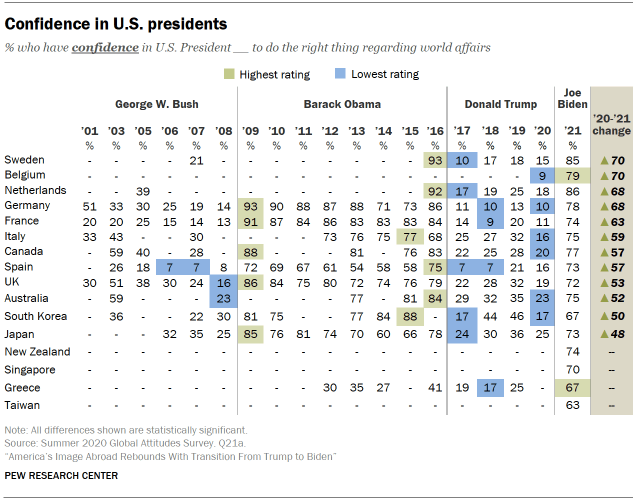
However, in Greece, confidence in the U.S. president is the highest it has been since Pew Research Middle first asked this question there. A much college share of Greeks have confidence in Biden compared with Obama in 2016 and earlier. Notably, Biden has shared a positive relationship with Greek Prime Minister Kyriakos Mitsotakis, and Greeks are more twice as likely now to say the U.S. takes their country'southward interests into account when making policy decisions (53%) than they were when Obama was president (xx% in 2013).
Biden more than trusted than Putin and 11, less trusted than Merkel
Publics express much more conviction in Biden than in Russian President Vladimir Putin or Chinese President Xi Jinping. Biden besides fares well in comparing with French President Emmanuel Macron, just his ratings tend to trail those of German language Chancellor Angela Merkel.
A median of 77% have conviction in Merkel to exercise the right affair in earth affairs. She receives somewhat higher ratings in holland, Sweden, Spain, Kingdom of belgium, France, New Zealand and Australia than in her home country, though a large majority of Germans still express confidence in the chancellor. Of the xvi publics surveyed, Hellenic republic is the only one where fewer than one-half concur this view. Organized religion in Merkel has likewise increased since the summertime of 2020 in six of the 12 countries where information is available for both years.
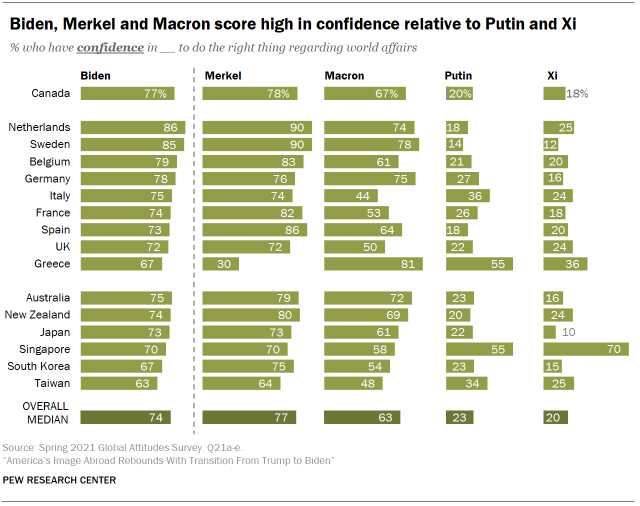
A median of 63% take confidence in Macron when it comes to his treatment of world diplomacy. Roughly eight-in-ten or more agree this view in Greece and Sweden. As with Merkel, Macron'due south ratings in his home country are positive, but more than subdued than in other publics; 53% of people in France trust the French president to do what is right in international diplomacy.
Medians of only around ane-in-v express confidence in Putin or Eleven. Singapore and Greece are the simply countries where more than half trust either president; 55% in both Hellenic republic and Singapore say they have confidence in Putin, and lxx% in Singapore say the same of Xi.
Ratings for the Chinese president have been consistently low in many countries, particularly across the Western European nations surveyed, since this question was first asked in 2014. Opinion of Putin in these countries extends back even further and shows a similarly negative design there.
Biden seen as well-qualified to be president
Reflecting high levels of confidence in the U.South. president, overwhelming majorities say Biden is well-qualified for the position, and many come across him equally a strong leader. Very few view Biden as either dangerous or big-headed. And in well-nigh cases, these views are in stark contrast to views of his predecessor.
A median of 77% think Biden is well-qualified for his role equally president, ranging from 64% in Japan to 84% in Sweden. Among many of these same publics polled in 2017, only a third or fewer saw Trump as well-qualified.
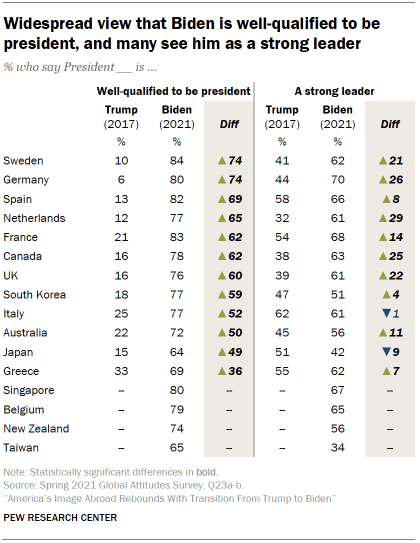
The gap betwixt perceptions of the 2 American presidents is particularly broad in Sweden and Federal republic of germany. Only 10% of Swedes thought Trump was well-qualified to be president during his showtime year in part. In the current survey, 84% meet Biden as qualified, a 74 percentage point difference. Among Germans, half-dozen% thought Trump was well-qualified, compared with eight-in-ten who say the same of Biden this year.
A difference of roughly 50 points or more on this question appears in near every country where data is bachelor for both leaders.
Biden and Trump are viewed the most similarly when it comes to perceptions of them as strong leaders. In 2017, relatively big shares saw Trump as a strong leader, even in countries where few had confidence in him to do the right thing in world affairs. In countries where information is available for both leaders, more than people tend to see Biden as a strong leader, only in several countries, the departure is comparatively small.
Very few people across the publics surveyed call up Biden could be described as unsafe (median of 14%) or arrogant (median of 13%). This is a striking difference from how Trump was viewed early in his presidency.
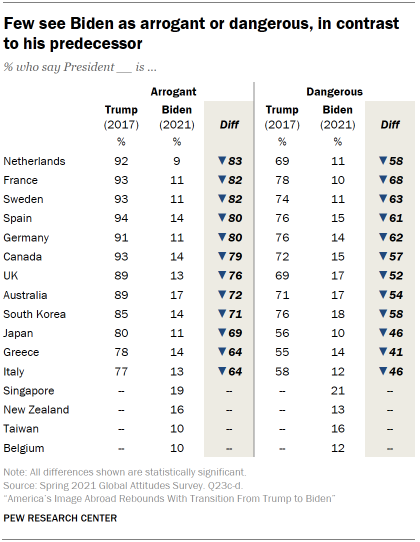
For case, there is an 83-point difference in the Netherlands between those who viewed Trump equally arrogant (92%) and those who currently say the same almost Biden (ix%). Differences of roughly lxxx points or more on this question can also be seen in France, Sweden, Kingdom of spain, Germany and Canada.
Similarly, majorities in each country saw Trump as unsafe in 2017, while no more 21% concord this view of Biden, resulting in differences of roughly 40 points or more in countries where information is available for both leaders.
Biden's strange policy agenda broadly pop across advanced economies
The Biden administration'due south foreign policies included on the survey enjoy widespread popularity. Of the 4 policies tested, the Us' reentry into the Globe Health System (WHO) garners the nearly approval, with a median of 89% saying they support the motion. Support for this policy is almost prevalent in Europe, where shares ranging from 86% to 94% approve of the U.S. returning to the organization. The move is too broadly popular in Canada and the Asia-Pacific.
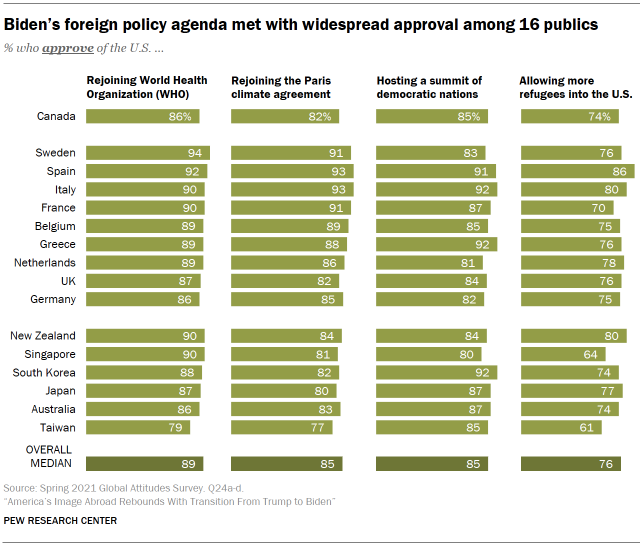
Biden's decision to recommit to the Paris climate agreement is also very well received. A median of 85% approve of the U.Southward. rejoining the accordance. Across Europe, about nine-in-10 or more than across vi countries polled favor the move, with respondents in kingdom of the netherlands, Germany and the Britain following closely behind. Shares of roughly viii-in-ten or greater are also supportive in Canada and the Asia-Pacific region.
Rejoining the accord represents a reversal from former President Trump'south conclusion to withdraw the U.S. from the understanding, a move that was met with widespread disapproval when Pew Research Centre asked virtually it in 2017.
In all countries the Eye surveyed both this yr and four years ago, Biden'due south approach is considerably more popular than Trump's. For case, in Espana, but 8% approved of Trump withdrawing support for international climate agreements in 2017, while 93% approve of the U.S. rejoining the Paris understanding this year, an 85 pct point divergence. In every country, rejoining the agreement is met with approval from shares at least four times as large equally the shares who supported leaving it.
In add-on to Biden'south reversal of Trump-era withdrawals from international organizations and pacts, his plans for the U.S. to host a meridian of democratic nations earns widespread approval. Across the sixteen publics polled, a median of 85% express support for the convening, and in each, eight-in-10 or more say they favor the plan.
Attitudes toward this policy amongst several publics are divided by views of American democracy. Among most publics surveyed, those who think the U.Southward. is a good example of democracy for other countries to follow support the superlative more than those who think the U.S. has never been a good example. For example, in Sweden, 91% of those who remember the U.S. is currently setting a good example of democratic values corroborate of the U.S. convening leaders from other democracies, compared with 71% of those who doubt the U.S. has ever ready a good example of democracy, a twenty-point difference.
Those who view the U.Southward. as a reliable partner are more likely to approve of the U.S. hosting a summit of democratic nations in xiii of the publics surveyed. For case, in Germany, 89% of those who remember the U.S. is a reliable partner corroborate of this policy, whereas but 68% of those who view the U.S. as unreliable concur, a 21-point deviation.
Approval of Biden's programme to increase the number of refugees allowed into the U.South. is also widespread. A median of about three-quarters support the change, and nowhere do fewer than half dozen-in-x agree with the conclusion. This comes as Biden reversed his initial goal to enhance the refugee cap in the U.South. from the levels ready by the Trump assistants, but and then walked back the reversal amidst criticism.
Source: https://www.pewresearch.org/global/2021/06/10/americas-image-abroad-rebounds-with-transition-from-trump-to-biden/
0 Response to "The World Respects Us Again Trump"
Post a Comment